


Single Rotation vs Dual Rotation Gun Drilling Machine
Choosing the correct gun drilling machine is one of the most important decisions in deep-hole machining. The machine configuration affects not only drilling speed, but also hole straightness, roundness, tool life, honing allowance, and long-term production cost.
In practice, many manufacturers focus on machine price first and discover later that the chosen structure cannot meet the requirements of long hydraulic cylinder tubes, piston rods, or thick-wall steel components. The result is excessive tool wear, unstable straightness, and additional finishing work.
This guide explains the differences between single rotation and dual rotation gun drilling machines in practical terms. Whether you produce hydraulic cylinders, honed tubes, seamless steel tubes, or precision deep-hole components, the following comparison will help you select the most suitable configuration.
Table of Contents
What Is a Single Rotation Gun Drilling Machine?
What Is a Dual Rotation Gun Drilling Machine?
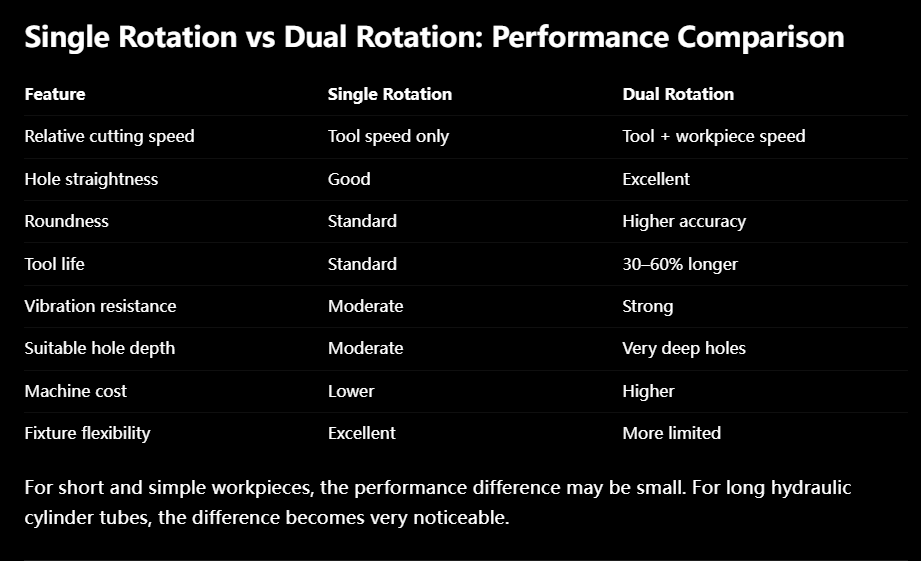
Performance Comparison
Why Dual Rotation Performs Better in Long Deep Holes
When to Choose Single Rotation
When to Choose Dual Rotation
Selection Guide for Hydraulic Cylinder Manufacturers
Frequently Asked Questions
Final Recommendation
What Is a Single Rotation Gun Drilling Machine?
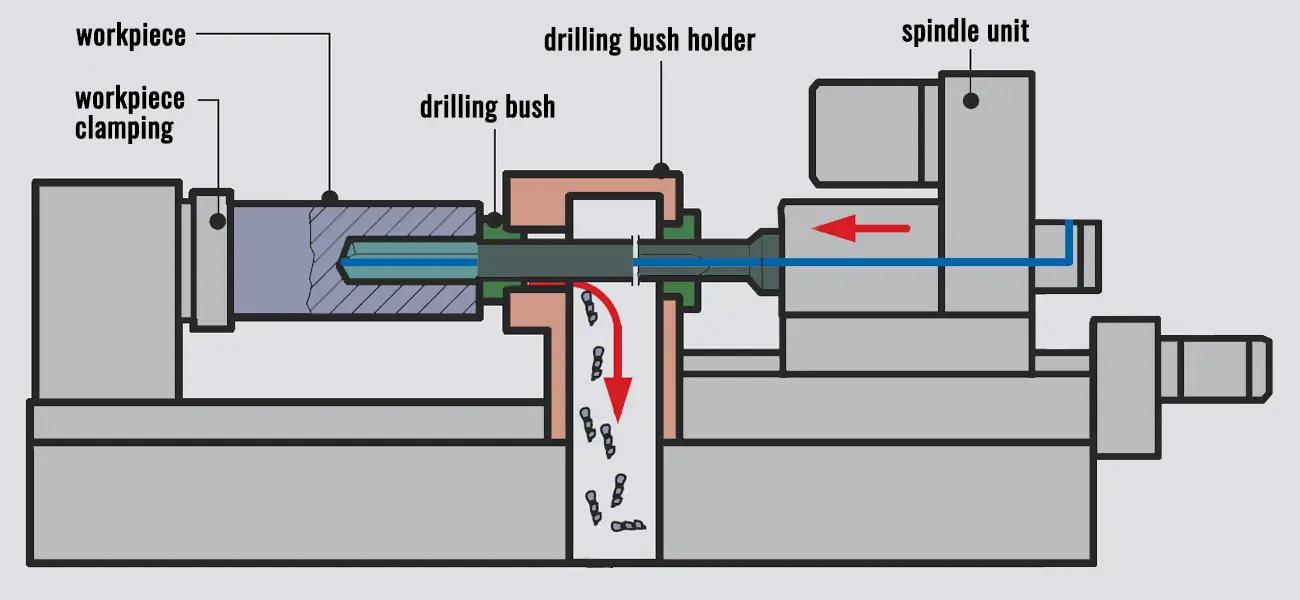
In a single rotation gun drilling machine, only the gun drill spindle rotates while the workpiece remains stationary. The drill rotates and feeds into the material, and coolant carries chips out through the drilling system.
This is the most common and economical gun drilling structure. Because the workpiece does not rotate, fixturing is relatively simple and setup time is short.
Single rotation machines are widely used for:
Hydraulic valve blocks
Mold cooling channels
Short shafts and bushings
Small precision holes
Irregular or eccentric workpieces
Small-batch production
For many applications, especially holes with moderate depth and diameter, single rotation provides sufficient accuracy at a lower investment cost.
What Is a Dual Rotation Gun Drilling Machine?
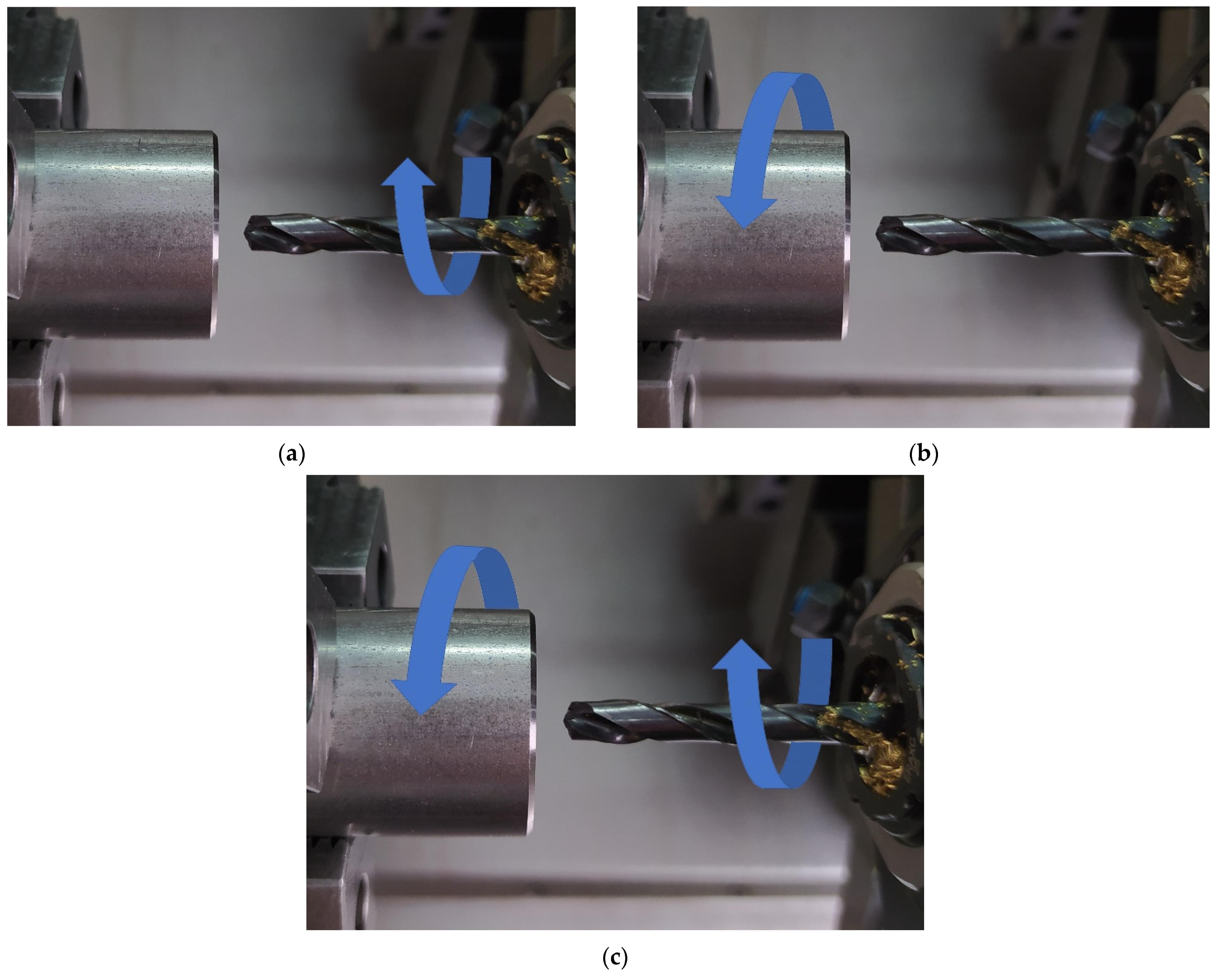
In a dual rotation gun drilling machine, both the tool spindle and the workpiece rotate simultaneously, usually in opposite directions. The relative cutting speed is therefore higher than the spindle speed alone.
A typical example is:
Tool rotation: 1500 rpm
Workpiece rotation: 500 rpm (opposite direction)
Effective relative cutting speed: equivalent to 2000 rpm
This structure requires an additional workpiece spindle and servo drive, making the machine more expensive. However, the benefits become significant when drilling long, deep, and high-precision holes.
Why Dual Rotation Performs Better in Long Deep Holes
Why Dual Rotation Performs Better in Long Deep Holes
1. Higher Effective Cutting Speed
Because the workpiece rotates opposite to the tool, the cutting speed increases without forcing the spindle to run at extremely high rpm. This reduces spindle heat generation and improves stability.
2. Better Force Balance
In single rotation drilling, side cutting forces act continuously in one direction. Over a long drilling distance, the drill tube gradually deflects, causing hole deviation.
In dual rotation drilling, the rotating workpiece changes the force direction continuously. The guide pads experience a more balanced load, and drill deflection is reduced.
This is one of the main reasons why dual rotation achieves better straightness in holes with high length-to-diameter ratios.
3. Improved Chip Evacuation and Cooling
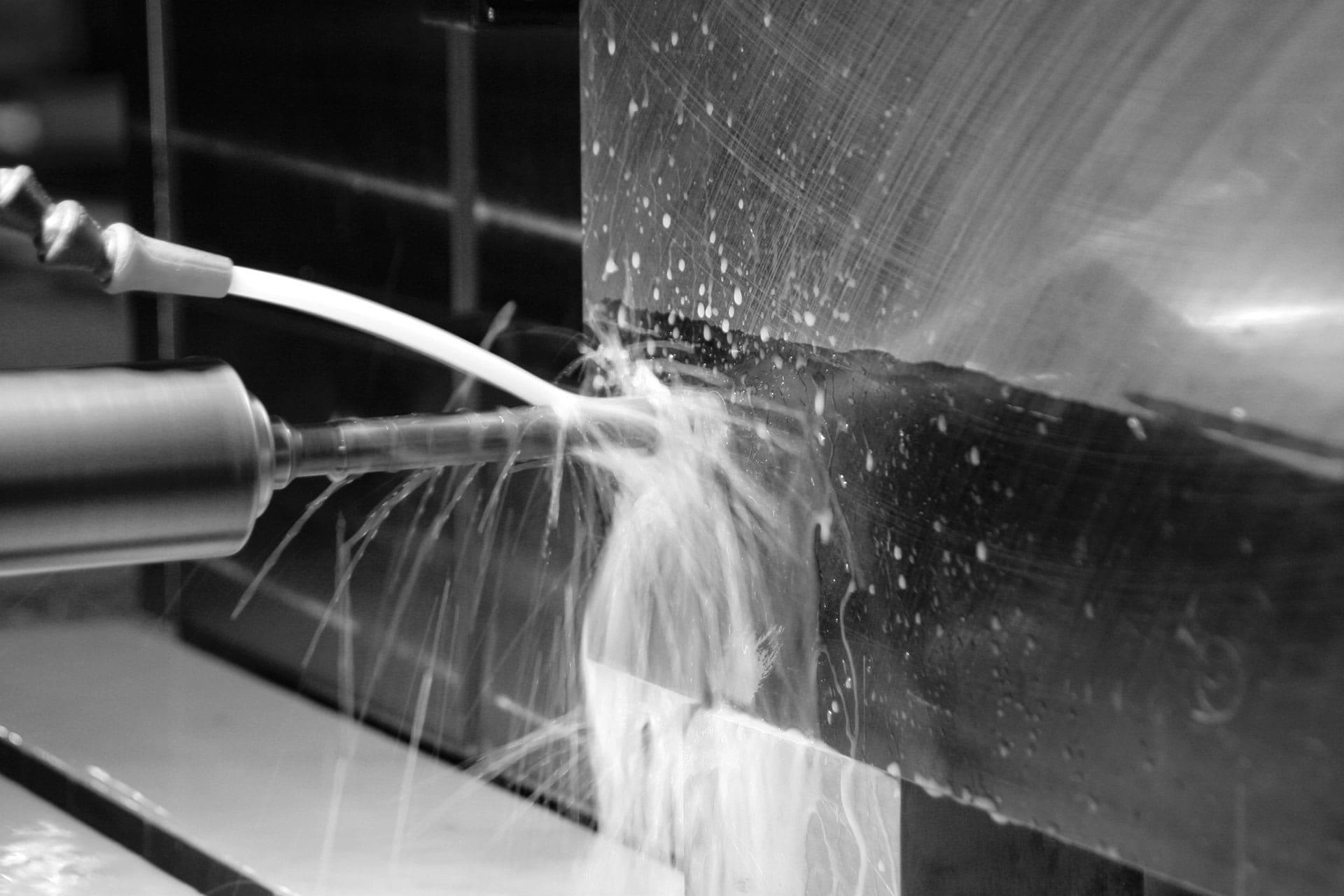
Deep-hole drilling generates large amounts of heat. Dual rotation promotes more uniform chip flow and coolant distribution, which helps prevent chip blockage and improves surface finish.
For hydraulic cylinder tubes, this means a more consistent pre-honing bore and less correction work during honing.
When Should You Choose Single Rotation?
A single rotation machine is usually the better choice when:
The workpiece is short and rigid.
Hole depth is moderate.
The part shape is irregular or eccentric.
Multiple hole positions require flexible fixturing.
Production batches are small.
Budget is the primary concern.
Typical examples include mold cooling channels, hydraulic valve blocks, short sleeves, and precision small-hole components.
For hole diameters below approximately 10 mm, single rotation is often preferred because the workpiece does not need to rotate and setup is faster.
When Should You Choose Dual Rotation?
Dual rotation becomes the preferred solution when:
Hole depth exceeds several hundred millimeters.
Length-to-diameter ratio is high.
Workpieces are long cylindrical tubes or rods.
Straightness and concentricity are critical.
Material is 45#, 40Cr, alloy steel, or thick-wall tubing.
Production volume is large and cycle time matters.
Typical applications include hydraulic cylinder tubes, honed tubes, piston rods, seamless steel tubes, and other long rotational components.
In these cases, the higher machine cost is usually recovered through better productivity and lower tooling consumption.
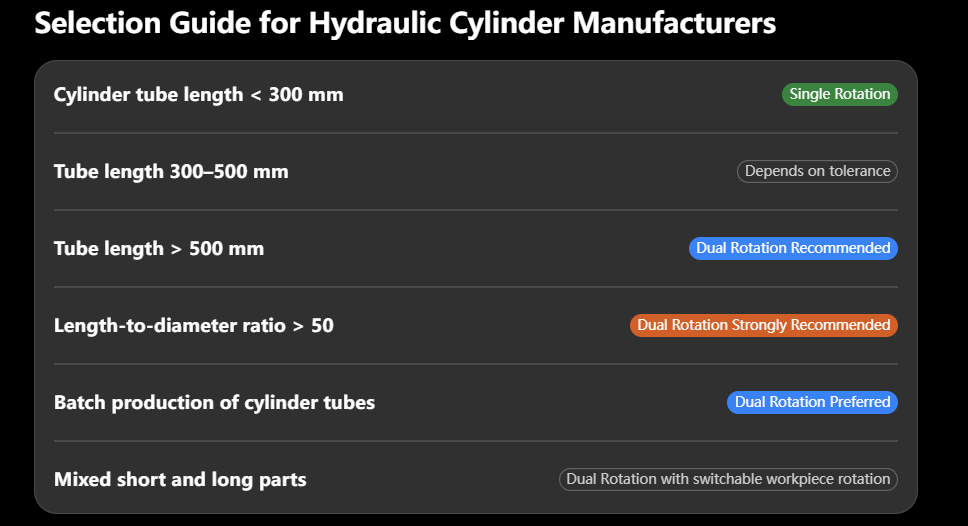
Many hydraulic cylinder factories process both short sleeves and long tubes. In that situation, a dual rotation machine with an option to disable workpiece rotation provides the best flexibility. The machine can operate as a dual rotation system for long tubes and as a single rotation system for irregular short parts.
Frequently Asked Questions
1.Can a dual rotation machine work as a single rotation machine?
Yes. Many modern CNC gun drilling machines allow the workpiece spindle to be stopped, effectively converting the machine into single rotation mode.
2. Is dual rotation always better?
No. For short, irregular, or eccentric parts, single rotation is often more practical and economical.
3. Does dual rotation improve tool life?
Generally yes. Because cutting forces are better balanced and vibration is reduced, gun drill wear is typically lower than in comparable single rotation applications.
4. Which machine is better for holes deeper than 1000 mm?
For most cylindrical workpieces, dual rotation provides better stability and straightness at this depth range.
5. Can small holes be drilled with dual rotation?
Yes, but for very small diameters the additional complexity is often unnecessary unless the workpiece is extremely long.
Final Recommendation
There is no universally “best” gun drilling machine. The correct choice depends on the workpiece geometry, hole depth, tolerance requirement, and production target.
As a practical rule:
Choose single rotation for short parts, irregular components, mold applications, and small-batch production.
Choose dual rotation for hydraulic cylinder tubes, long piston rods, deep precision holes, and high-volume manufacturing.
Choose a switchable dual rotation machine if your workshop processes both long cylindrical parts and shorter irregular parts.
For hydraulic cylinder manufacturers, dual rotation is usually the most future-proof investment because it delivers better straightness, more uniform honing allowance, longer tool life, and higher production efficiency on long tube applications.
 CNC Deep Hole Machine Tools fo
ماكينات CNC لتشغيل الثقوب العم
Machines CNC d’usinage de trou
CNC Deep Hole Machine Tools fo
CNC Deep Hole Machine Tools fo
ماكينات CNC لتشغيل الثقوب العم
Machines CNC d’usinage de trou
CNC Deep Hole Machine Tools fo